
Lviv Walking Tours: Top Routes 2026
Lviv is a city built for walking. Compact, pedestrian-friendly, and endlessly layered with history, every street and courtyard tells a story. While guided tours are available (and sometimes excellent), many of Lviv's best discoveries happen when you simply wander with intention.
Here are six self-guided walking routes through Lviv, each offering a different perspective on the city. All routes start in the city center, take a few hours, and require nothing but comfortable shoes and curiosity. Opening hours and ticket prices below come from our venue cards — check them before you go.
Route 1: The Grand Tour of Old Town
Time: 2.5-3 hours | Difficulty: Easy
The essential Lviv walk, covering the major landmarks. Perfect for first-time visitors.
Starting point: Svobody Avenue (Freedom Avenue)
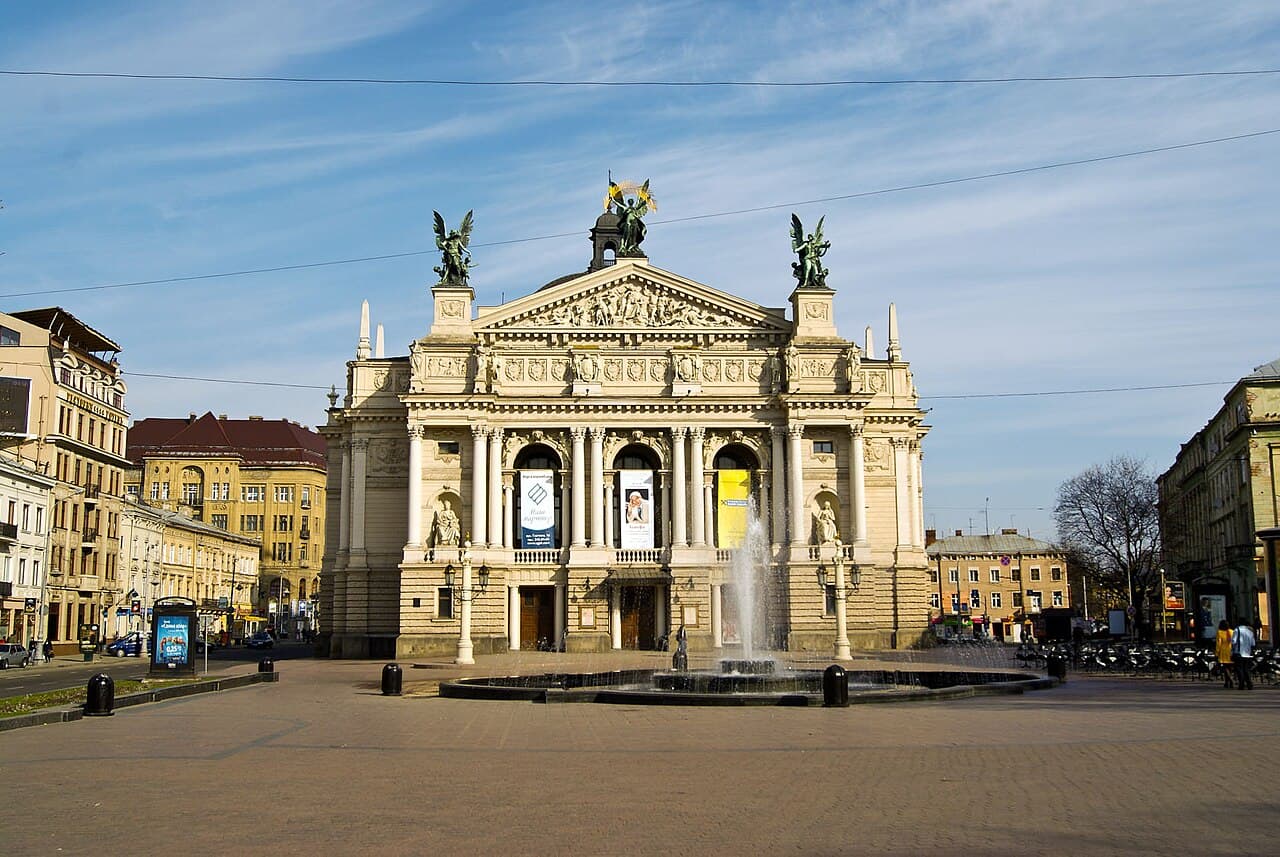
- Lviv National Opera (Svobody Ave, 28) — Start here and admire the neo-Renaissance facade. The building went up in 1897-1900 and opened on 4 October 1900. Daytime building tours: 100 UAH entrance (50 UAH reduced), guide fee per group extra.
- Walk down Svobody Avenue past the Shevchenko Monument toward Mickiewicz Square.
- Enter the old town through Halytska Street.
- Rynok Square (Market Square) — The heart of Lviv, laid out in the late 13th century. Four early-19th-century fountains at the corners feature Neptune, Amphitrite, Diana and Adonis. The Black Stone House (#4, now the Museum of the History of Lviv) and Korniakt Palace (#6) are architectural highlights.
- Latin Cathedral (Katedralna Square, 1) — A Gothic basilica begun in the 1380s, with Mayer stained glass from 1892-1899. Free entry; Mon-Sat 08:30-17:00, Sun 14:00-17:30 (no sightseeing during services).
- Boim Chapel — Next to the cathedral, this 1609-1615 chapel has a west facade entirely covered in carved reliefs. Adult ticket 100 UAH; Wed-Sun 10:00-18:00.
- Virmenska Street (Armenian Street) — Home to the Armenian Cathedral (1363-1370), the oldest active church in Lviv, with a picturesque courtyard. Free entry, daily 09:00-19:00.
- Dominican Church (Muzeina Square, 1) — Late Baroque (1749-1764) with an elliptical dome. Free entry to the church; the Museum of the History of Religion is ticketed separately (100 UAH full).
- End at Pidvalna Street and the Arsenal Museum (Pidvalna St, 5) — a 1574-1575 city arsenal, daily 10:00-18:00, full ticket 100 UAH.
Coffee stop: Virmenka at Virmenska St, 19 (about halfway through).
Route 2: Hidden Courtyards & Passages
Time: 1.5-2 hours | Difficulty: Easy
Lviv's true character hides behind closed doors. This route takes you through courtyards that many tourists miss.
Starting point: Rynok Square
- Italian Courtyard (Rynok Square, 6) — The courtyard inside the Korniakt Palace, part of the Lviv Historical Museum.
- Walk along Virmenska Street and look into the courtyards — the Armenian Cathedral courtyard with its galleries is the best known.
- Dzyga Art Center (Virmenska St, 35) — set in the former Dominican monastery; the gallery is free to enter.
- End at Gasova Lyampa (the Kerosene Lamp restaurant-museum), Virmenska St, 20 — dedicated to the kerosene lamp, invented in Lviv in 1853 by pharmacists Jan Zeh and Ignacy Łukasiewicz. Mon-Fri 12:00-23:00, Sat-Sun 11:00-23:00.
Tip: Many old-town courtyards are residential — be quiet and respectful when you look inside.
Route 3: High Castle & Lychakiv
Time: 2-2.5 hours | Difficulty: Moderate (uphill sections)
A green hilltop park followed by one of Europe's most remarkable cemeteries.
Starting point: Pidvalna Street (City Arsenal)
- Walk along Zamkova Street toward High Castle Hill — one of the park's entrances is from this street. The climb is steep, with stairs and winding paths.
- High Castle — the highest point of Lviv: the artificial Union of Lublin Mound reaches 413 meters above sea level, but its viewing platform is currently closed to visitors. Only a fragment of the castle wall remains. Free entry.
- Head east to Lychakiv Cemetery (Mechnikova St, 33) — a state museum-reserve founded in 1786, about 42 hectares with around 500 sculptures and reliefs. Notable graves include Ivan Franko, Solomiia Krushelnytska and the songwriter Volodymyr Ivasiuk. Daily 09:00-18:00; admission 100 UAH (80 UAH student/school). Allow 1.5-2 hours.
- Return to the center via Lychakivska Street.
Best time: daytime — Lychakiv Cemetery closes at 18:00.
Route 4: Jewish Heritage Trail
Time: 1-2 hours | Difficulty: Easy
A solemn and important walk through the history of Lviv's Jewish community, one of the largest in the city before World War II.
Starting point: Staroyevreyska Street (Old Jewish Street)
- Staroyevreyska Street — The name itself tells the story: this was the heart of the old Jewish quarter.
- Space of Synagogues — A memorial space on the site of the Golden Rose synagogue, blown up by the Nazis in 1943, and the Beit Hamidrash. The memorial installation was designed by Berlin architect Franz Reschke.
- Former Ghetto area — Zamarstynivska Street, where the Lviv Ghetto was established in 1941.
- Yanivske Cemetery memorial — Commemorates the victims of mass executions nearby.
- Return to the center via Krakivska Street.
Route 5: Creative Lviv
Time: 2 hours | Difficulty: Easy
This route connects two of the city's best-known creative spaces.
Starting point: Virmenska Street
- Dzyga Art Center (Virmenska St, 35) — the legendary art centre founded in 1993: a gallery with changing exhibitions (free entry), a café and a shop, plus jazz and electronic concerts. Mon-Wed 12:00-22:00, Thu-Fri 12:00-23:00, Sat-Sun 10:00-23:00.
- !FESTrepublic (Staroznesenska St, 24-26) — a creative quarter on the site of the former Halychsklo glassworks, about 20 minutes on foot from Rynok Square. It houses !FEST venues, a Pravda brewery, a Staryi Lev bookshop and a club and concert venue; each venue keeps its own hours.
Route 6: Austro-Hungarian Architecture
Time: 2.5-3 hours | Difficulty: Easy
For architecture lovers — this route focuses on buildings from Lviv's period as part of the Habsburg Empire (1772-1918).
Starting point: Railway Station
- Lviv Railway Station — A Secession-style station opened in 1904, designed by Władysław Sadłowski.
- Church of Sts Olha and Elizabeth (Marka Kropyvnytskoho Sq, 1) — the neo-Gothic church right opposite the station.
- Potocki Palace (M. Kopernyka St, 15) — Built in 1875-1883 for Count Alfred II Potocki, now a branch of the Lviv National Art Gallery; the ground-floor state rooms in Louis XVI style survive. Wed-Sun 10:00-18:00; adults 200 UAH.
- Lviv House of Scientists (Lystopadovoho Chynu St, 6) — Neo-Baroque, 1897-1898, by Fellner & Helmer; from 1918 to 1939 it housed the Noble Casino. The mirror, red, silver, white and theatre halls survive. Tour prices are not published — ask the venue.
- Lviv National Opera — Revisit the exterior and study the sculptural details: bronze figures of Glory, the Genius of Drama and Music crown the roof.
- End at the Ivan Franko National University (Universytetska St, 1) — the former Galician Diet (Sejm) building.
Best time: Morning, before the crowds.
Practical Tips for Walking Lviv
Footwear: Cobblestones are everywhere and can be uneven. Wear sturdy, flat shoes with good grip. Heels are a bad idea.
Water and snacks: Carry a water bottle. Grab a coffee at one of the many cafes along every route.
Maps: Download an offline map of Lviv before you go.
Weather: Lviv weather is unpredictable. A compact rain jacket is a good idea for most of the year.
Guided alternatives: If you prefer a guide, Walkative! Free Walking Tour runs pay-what-you-want tours in English; the 2-hour "Welcome to Lviv! Old Town" walk meets at the Neptune fountain on Rynok Square — see the organiser's website for the schedule and booking. The Tourist Information Centre in the City Hall runs group tours (250 UAH adult / 200 UAH child under 13) and private tours from 750 UAH per hour in Ukrainian or 1,000 UAH per hour in English or Polish (up to 4 people).
Every walk through Lviv reveals something new — a detail you missed before, a courtyard you hadn't noticed, a story you hadn't heard. That's the magic of this city. It rewards those who look closely.